
Home › Blog › Crowd & Behaviour › Why Markets Move Before the News
Why Markets Move Before the News — Price Anticipation, Institutional Positioning, and Why Retail Investors Always Miss the Window
By Neo & Teo | TrendTurtles · 7 min read · Published: June 2026
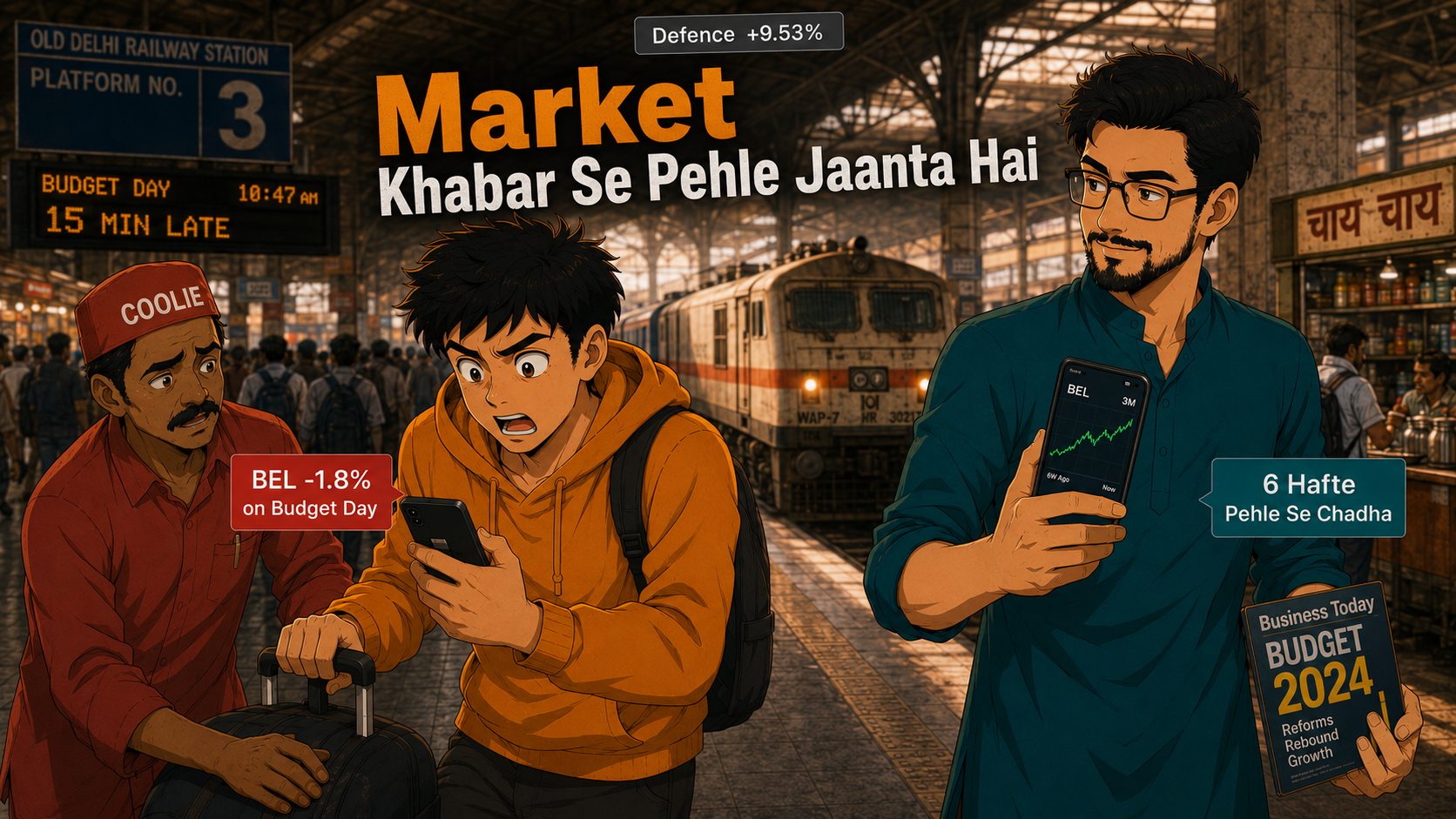
HAL surged 5% and BEL jumped 9% before Budget 2025 was announced — weeks after both had already been climbing on institutional anticipation. Defence allocation rose 9.53% to Rs 6.81 lakh crore, but by the time Nirmala Sitharaman said the number out loud, the move was done. This is not insider trading. This is price anticipation — the one mechanism that costs retail traders money every Budget, every RBI policy day, every earnings season. Here is what actually happened, why it always happens, and what to do about it.
The platform smells of chai, coal dust, and impatience. Train: 15 minutes late.
Teo is on the bench. Earphones in. Knee bouncing. Finance Minister Nirmala Sitharaman is live on his phone screen, walking up to the podium.
He bought Bharat Electronics Limited (BEL) last night. Three Twitter accounts said defence budget badhega. A WhatsApp group had a "CONFIRMED SOURCE." He went in.
Next to him, Neo has Economic & Political Weekly open on his lap. Reading it like someone who already knows how the day ends.
The announcement comes: defence allocation up 9.53%. Teo almost pumps his fist.
He opens his brokerage app.
BEL: down 1.8%.
He refreshes. Still red.
Usi waqt ek coolie red shirt mein aata hai — seedha Teo ke trolley bag ko haath lagata hai.
"Saab, utha doon?"
"Hatt bhai! Aaj sab ne milke loot liya hai mujhe — tu bhi aa gaya?!" — Teo to the coolie, phone trembling in his left hand.
The coolie steps back, genuinely confused.
Neo looked up from his magazine. One glance at Teo's screen. One glance at Teo.
"Tune kab liya BEL?" — Neo to Teo, quietly.
"Kal raat. News thi na — defence budget badhega." — Teo to Neo, defensive.
"News thi. Price already bata raha tha — tune suna nahi." — Neo to Teo, back to the magazine.
Between November 2024 and January 2025 — two to three months before Budget Day — the following moves had already happened in defence stocks, sourced from Business Standard:
HAL: +5% in the 30 days before Budget day. Institutional buying visible in daily FII/DII data on NSE India.
BEL: +9% in the 6 weeks before the announcement. Volume had been 2.3x the 90-day average for three consecutive weeks before the Budget.
BDL: +7% in the same pre-Budget window. Order book updates had already been published in exchange filings.
On Budget Day itself — when the defence allocation number was read out — all three stocks opened flat to negative. The move was done. The retail investor who bought on the news was buying someone else's exit.
"Toh yeh log budget se pehle hi nikal gaye the?" — Teo to Neo, genuinely surprised.
"Kuch nikal gaye. Kuch held. Par entry toh November mein thi — February mein nahi." — Neo to Teo, simply.
DID YOU NOTICE?
The Economic Survey — published the day before the Union Budget every year — had specifically called out defence indigenisation and capital procurement as priority themes for FY26. It is a public document. Available free on indiabudget.gov.in. Institutional desks read it the night before. Retail traders were watching the live broadcast the next afternoon — by which point the positioning was already weeks old.
The market is a forward-looking mechanism. According to research published by SSRN on price anticipation, equity prices typically begin pricing an expected policy outcome 4 to 8 weeks before the official announcement. By the time the announcement is confirmed and on every news channel, the probability of the outcome has already moved from 50% to near 100% — and that entire move is already in the price.
Teo bought BEL when the probability of a higher defence budget was essentially confirmed. The stock had already priced in a 40–60% probability weeks earlier and a 90%+ probability in the final days. There was nothing left to price in.
When three Twitter accounts, two Telegram groups, and a WhatsApp forward all say the same thing — it feels like signal. It is noise with consensus.
By the time a theme is trending on social media, institutional positioning is done. The correct question is never "what are people saying?" It is "what has price already done?" Per J.P. Morgan India Market Outlook, retail participation in event-driven trades consistently peaks on announcement day — exactly when smart money is distributing.
"Yaar, toh main akela bewakoof nahi hoon — sab yahi karte hain?" — Teo to Neo, thodi relief ke saath.
"Sab karte hain. Isliye kaam nahi karta." — Neo to Teo, halka sa smirk.
Good news confirmed is a selling opportunity for early buyers — not a buying opportunity for late entrants.
The retail trader who buys on the news is providing exactly the exit liquidity that early money needs. Every time. This is not manipulation. It is just how price discovery works. As CMC Markets explains — anticipation drives the initial move, and confirmation triggers the reversal.
The goal is not to avoid news-driven sectors. The goal is to position with anticipation, not after confirmation.
TRIGGER 1 — GOVERNMENT BUDGET OR POLICY ANNOUNCEMENT APPROACHING
IF a sector theme appears in the Economic Survey or pre-budget ministry statements — and the sectoral index has not yet moved more than 8% from its 60-day base —
THEN consider staggered entry into the relevant sector ETF over 2–3 weeks before the announcement date. For defence: Mirae Asset Nifty India Defence ETF (NSE: NIDEFENCE).
SOURCE: Economic Survey — indiabudget.gov.in + NSE Sectoral Indices
AVOID: Entering after the index has already moved 10%+ in the 30 days before the event. The window is closed.
TRIGGER 2 — CENTRAL BANK MEETING APPROACHING
IF RBI MPC meeting is scheduled and bond yield movement shows strong probability of a rate cut —
THEN watch rate-sensitive sectors 10–15 days before the announcement, not after. Track via Nifty Bank and Nifty Financial Services indices on NSE.
SOURCE: RBI Press Releases + bond yield data on NSE
AVOID: Buying bank stocks the morning of the RBI announcement — institutional selling into confirmed news is likely.
TRIGGER 3 — QUARTERLY EARNINGS APPROACHING
IF a large-cap stock is approaching earnings with analyst consensus showing strong YoY profit growth AND the stock has underperformed its sector in the prior 30 days —
THEN this is a potential anticipation setup. Watch volume build in the 2 weeks before results. Source: BSE Corporate Announcements for earnings dates.
SOURCE: BusinessToday — pre-earnings sector anticipation
AVOID: Adding size on the day earnings are reported — reaction is unpredictable even on strong beats.
"Toh aage se main kya karun — news hi nahi dekhun?" — Teo to Neo, station peeche chhoot gaya, train speed pe.
"News dekh. Bas chart pehle dekh. Price already bata raha hota hai — sun." — Neo to Teo, magazine wapas kholta hua.
The market is not smarter than you. It is just earlier than you.
Institutions read the same Economic Survey, the same ministry statements, the same global data. But they act on probability — before confirmation. That window, between probability forming and news confirming, is where returns live.
After the announcement, you are not trading information. You are trading other people's exits.
Teo looked out the window at the blur of platforms passing. The phone went face-down on the seat.
Know someone who bought a stock on announcement day and watched it go red despite good news? Tag them or send this across — LinkedIn, Facebook, Instagram, YouTube.
1. Markets price probability, not news. HAL, BEL, BDL moved 5–9% before Budget 2025 was announced. The announcement itself was a non-event for price.
2. Good news + falling price = move already complete. This is not a malfunction. The anticipation phase is over. Early buyers are exiting into your entry.
3. Social media consensus is a lagging indicator. By the time a trade idea is trending on Twitter or Telegram, institutional positioning is done.
4. The window is between probability forming and news confirming. Not after. Read the Economic Survey. Watch volume. Track sectoral indices weeks before the event.
5. Retail buyers on announcement day are providing exit liquidity. Know which side of that trade you are on — before you place the order.
Trump. China. Sensex. — How the Beijing Summit Moved Indian Markets Before the Headlines
How India's 2026 Heatwave Moved AC Stocks — And Why the IMD Forecast Was the Real Signal
These articles give you the framework — so the next time a major announcement approaches, you already know what to watch.
Stock Double, Goa Ka Trip and FOMO — How Fear of Missing Out Destroys Portfolios
Why Retail Investors Lose Money — Three Behavioural Patterns As Per SEBI
What Is a Breakout — And Why Most Retail Traders Always Buy Too Late — coming soon