
Home › Blog › Crowd & Behaviour › Stock Double, Goa Ka Trip Or FOMO Ka Master Trap
FOMO-driven decisions cost retail investors far more than bad research ever does — and one unconfirmed Goa trip booking explains exactly why.
By Neo & Teo | TrendTurtles · 9 min read · Published: June 2026
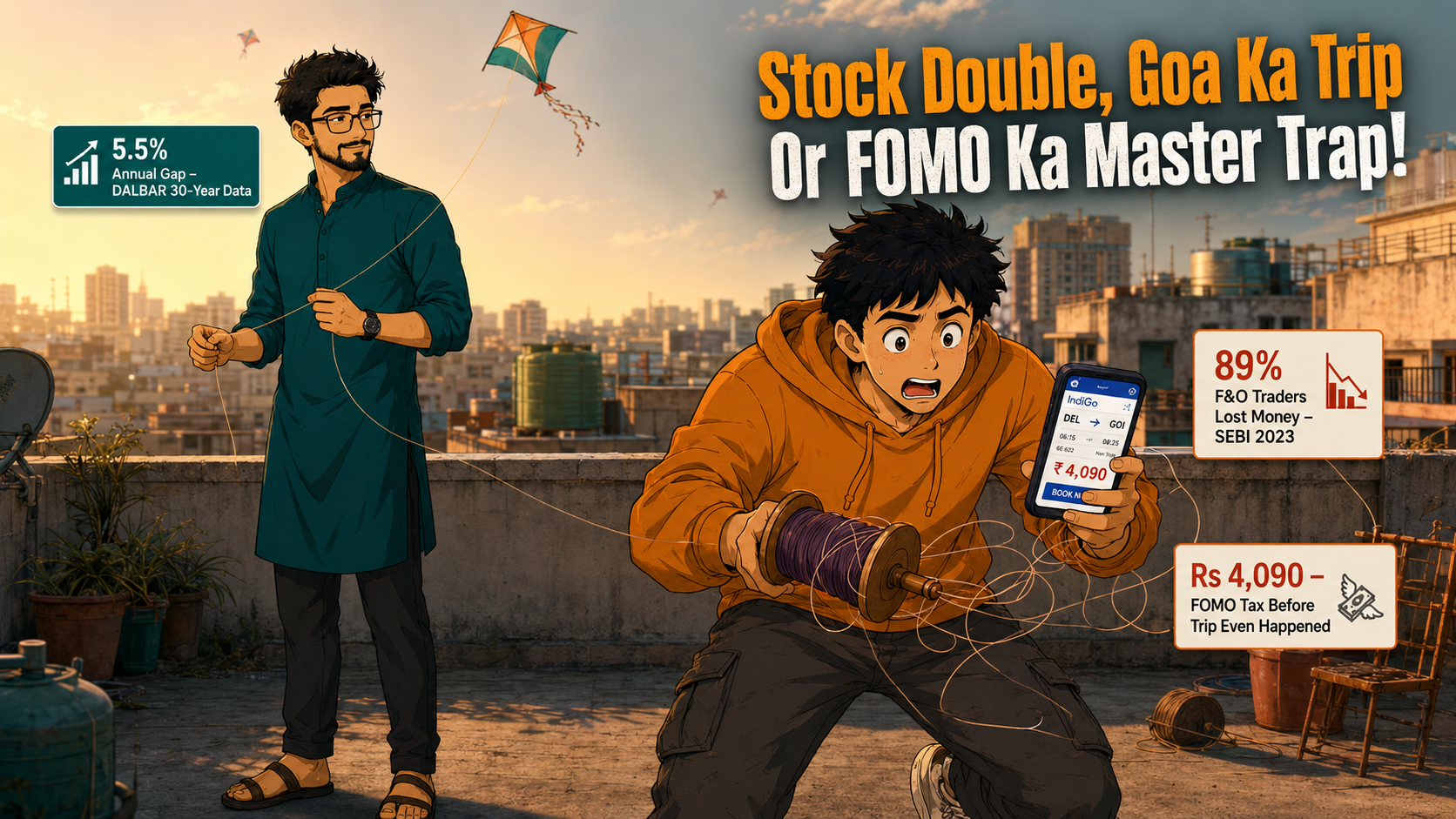
It is a Sunday afternoon. Rooftop. The kind of October weather that makes Delhi feel worth living in. Neo is flying a kite — properly, both hands on the string, reading the wind before every move. Teo is supposed to be managing the kite reel.
He is not managing the reel. He is booking a flight.
The group chat started at 10 AM. Someone dropped a screenshot of IndiGo fares — Goa, long weekend, looking good. Twelve thumbs-up emojis. Three fire emojis. One "let's do it yaar" from Rohan, who has not committed to a single trip in four years.
"Bhai yeh 4,200 se 5,800 ho gaya subah se — agar abhi nahi kiya toh milega nahi." — Teo to Neo, kite reel in one hand, phone in the other, IndiGo payment page open on screen.
The kite dips slightly. Neo pulls the string left, corrects it without looking at Teo.
"Kitno ne confirm kiya abhi tak?" — Neo to Teo, eyes still on the kite.
"Woh toh... confirm nahi hua exactly. But sab jaana chahte hain." — Teo to Neo, thumb hovering over Pay Now.
Neo says nothing. The kite reel slips in Teo's grip — thread tangling, unwinding too fast in the wrong direction. Teo scrambles to fix it with one hand, phone in the other, making it worse.
"Bhai, koi kaam toh sahi se karle." — Neo to Teo, flat, still watching the kite, mild exasperation.
Teo pockets the phone. Uses both hands. Fixes the reel. Ten seconds of silence pass.
"Maine book kar li." — Teo to Neo, quietly. "Agar nahi bana toh cancel kar dunga."
"Cancel charges kitne hain?" — Neo to Teo, same tone, not looking away from the sky.
Teo opens the IndiGo app. Cancellation fee: Rs 3,500. Non-refundable convenience fee: Rs 590. Total loss for a trip that has not happened yet: Rs 4,090.
"Yaar yeh toh..." — Teo to Neo, trailing off, reel still in both hands, going nowhere.
Three people reacted with a thumbs-up in the group chat. Rohan reacted with a laughing emoji. Nobody else booked that day.
Three weeks earlier, Teo had done something almost identical — just with a different kind of string in his hand. His college friend Arvind called on a Friday evening. Said he had entered a mid-cap pharma stock. Said it was "pakka double." Said a few others from their group were already in.
Teo did not check the balance sheet. Did not look at the promoter holding. Did not read the quarterly numbers. He opened Zerodha at 9:16 AM the next Monday — the stock was already up 6% from Friday's close — and bought anyway.
"Arvind bol raha tha double hoga. Already upar ja raha tha — pehle hi late ho gaya tha main." — Teo to Neo, kite reel resting on the terrace railing, both staring at the sky.
"Arvind ne kitna lagaya?" — Neo to Teo, string still steady.
"Woh pata nahi... usne bataya nahi exactly." — Teo to Neo, slower now.
"Aur tere paas kya data tha jab tune buy kiya?" — Neo to Teo, one eyebrow up, eyes still on the kite.
Teo does not answer. He knows. The data was a phone call. The confirmation was a group chat. The research was FOMO.
The stock corrected 22% over the next eleven trading sessions. Teo is still holding, waiting for it to come back.
Did You Notice?
Teo's Goa booking and his pharma stock buy were the same decision — same trigger, same logic, same outcome. In both cases the real signal was a group chat reaction, not confirmed information. He was holding the kite reel in both situations — just supplying string to someone else's move, calling it his own plan. The fear was not of losing money. It was of being the one left out.
FOMO activates after price has moved. Not before. The moment the group chat is talking about it, the early buyers have already entered. The SEBI January 2023 study — tracking 45.24 lakh individual traders executing over 1 crore trades across FY2019–FY2022 — found stocks bought during the top 5% of volume spikes underperformed Nifty 50 by 11.3% over the next 90 trading days. Teo bought pharma at a 6% premium to Friday's close. That 6% was the entire FOMO tax, paid upfront.
"Jo dikhta hai, woh already ho chuka hai. Tujhe data chahiye tha Friday ko — Monday ko nahi." — Neo to Teo, pulling the kite string left, steady.
"Matlab mujhe miss karna chahiye tha?" — Teo to Neo, genuinely asking.
"Miss karna tha nahi. Pehle dekhna tha." — Neo to Teo, approving nod.
Once a FOMO trade goes wrong, most retail investors hold — because selling means admitting the entry was emotional. The investor stops asking "is this stock worth holding?" and starts asking "when will it come back to what I paid?" One is about the business. One is about ego. Teo is holding a 22% loss waiting for a return to entry price that may take 18 months — or may never come.
"Bhai woh 22% neeche hai — agar bech diya toh nuksaan pakka ho jaayega." — Teo to Neo, shifting uneasily.
"Nuksaan already hua. Tu sirf acknowledge nahi kar raha." — Neo to Teo, flat, precise.
"Sirf 6 seats bacha hain." "Stock already 6% upar hai." These are urgency cues, not information. Kahneman and Tversky's Prospect Theory showed humans weigh potential losses roughly 2.5x more than equivalent gains — making scarcity framing extraordinarily effective at triggering impulsive action. Teo booked a flight and bought a stock for the exact same psychological reason: something felt like it was about to disappear.
"Toh main hamesha wait karoon? Kabhi buy hi nahi karoon?" — Teo to Neo, hands free of the reel, both arms up.
"Trigger data se aani chahiye — timer se nahi." — Neo to Teo, one smirk, handing Teo the reel back.
Did You Notice?
All three mistakes share one root: the decision trigger was an emotion, not a number. FOMO does not feel like fear in the moment. It feels like opportunity. That is the trap. By the time it feels like a mistake, you are already holding a loss and a non-refundable booking fee.
The kite is still flying. Neo has not lost it once. Teo has been watching the string more carefully now — both hands on the reel, phone in his pocket.
"DALBAR ne track kiya 30 saal ka data — average investor ne S&P 500 se 5.5% annually kam kamaya." — Neo to Teo, eyes on the kite.
"Matlab strategy kharab thi?" — Teo to Neo, frowning at the sky.
"Nahi. Strategy theek thi. Entry aur exit emotional thi." — Neo to Teo, straightening up.
The DALBAR 2024 QAIB report is the most comprehensive study of the investor behavior gap — the difference between what a fund returns and what its investors actually earn. Over 30 years, the S&P 500 returned approximately 10.3% annually. The average equity fund investor earned 6.3%. The gap was not fees. It was not bad funds. It was investors buying high on FOMO and selling low on panic — repeatedly, predictably, expensively.
"Yaar yeh toh mera exact story hai." — Teo to Neo, quietly, setting his phone face-down on the railing.
"Sabka hai. Isliye data se kaam karte hain." — Neo to Teo, eyes back on the kite.
Three data points that explain why FOMO is structurally built into how markets feel — not just how investors behave.
Nifty 50's best 10 trading days in any given year account for over 60% of its annual returns, according to Value Research's analysis of Nifty data from 2004 to 2023. Those days almost always fall inside a crash or correction — precisely when FOMO-driven investors have already sold.
"Best days aate hain worst weeks ke andar — jo bech deta hai FOMO mein, woh recovery bhi miss karta hai." — Neo to Teo, giving the string a small pull as the wind shifts.
"Toh FOMO crash mein aur zyaada activate hota hai?" — Teo to Neo, leaning forward.
"Dono direction mein. Rally mein buy karta hai. Crash mein sell karta hai. Dono baar late." — Neo to Teo, eyebrow up.
The same SEBI January 2023 F&O study covering 45.24 lakh individual traders found 89% lost money in equity derivatives, with an average annual loss of Rs 1.1 lakh per losing trader. Most entered during high-momentum, high-volatility sessions — classic FOMO conditions — rather than on pre-planned setups.
A University of California study published in the Journal of Finance tracked retail brokerage accounts over six years and found that stocks investors bought most enthusiastically — high buzz, high momentum, high news coverage — underperformed their other holdings by 3.3% annually. The stocks you are most excited about are, on average, your worst performers.
"Yeh toh ulta hai — jitna zyaada excited hoon utna zyaada loss?" — Teo to Neo, genuinely stunned.
"Excitement data nahi hai. Signal hai ki sab pehle se in hain." — Neo to Teo, smirk.
Three pre-set triggers that replace emotional decision-making with systematic ones.
Trigger 1 — When a Midcap Stock Surges 8%+ in a Single Session on No Fundamental News
IF a stock you do not already hold rises more than 8% in a single session on high volume with no earnings release, promoter announcement, or regulatory filing driving the move — THEN do not enter. Add it to a watchlist with a 20-day observation window. ETF alternative: Redirect capital to Mirae Asset Large & Midcap Fund (MAMLCF) via SIP for sector exposure without single-stock FOMO risk. Source: AMFI India Investor Education.
Avoid: Never chase a stock already circulating in a Telegram or WhatsApp "hot tip" thread — institutional exits are often already underway.
Trigger 2 — When Nifty 50 Drops 3%+ in 3 Consecutive Sessions
IF Nifty 50 falls more than 3% across three consecutive sessions and group chats shift to panic language — THEN this is not an exit signal. It is a review trigger. Check holdings against their original investment thesis. If unchanged, hold or add. ETF option: UTI Nifty 50 Index Fund (UTINIFETF) — buy a tranche if Nifty is 8% or more below its 52-week high. Source: NSE India Live Market Data.
Avoid: Never sell index funds during a correction triggered by global macro noise with no India-specific fundamental damage.
Trigger 3 — When a "Sure Shot" Tip Arrives via Social Proof
IF someone tells you a stock is "pakka double" and cites that others have already entered — THEN apply a 48-hour rule. Check promoter holding trend on BSE shareholding pattern, check last two quarterly results on Screener.in, and verify if institutional holding is rising or falling. If you cannot find three independent data points supporting the thesis, do not enter.
Avoid: Never size a tip-based position at more than 2% of your portfolio, regardless of conviction level.
The sun is lower now. The other kites in the sky have mostly disappeared. Neo's kite is still up — steady, unhurried. Teo has the reel in both hands, finally. He has not checked his phone in eleven minutes.
"Dono mein ek hi galti ki. Dono mein confirm nahi tha kuch bhi." — Teo to Neo, looking at the reel, not the phone.
"Yahi FOMO ka design hai — confirm hone se pehle decide karwata hai." — Neo to Teo, slight smirk back.
"Toh wait karna chahiye tha?" — Teo to Neo.
"Trigger wait karna chahiye tha. Trip confirm hone ke baad book karna tha. Stock ka thesis confirm hone ke baad buy karna tha." — Neo to Teo, approving nod.
Teo sets his phone face-down on the terrace railing. First time all day.
"Ohh. Samajh aaya." — Teo to Neo, quietly. Both hands on the reel.
Did You Notice?
Teo did not lack intelligence. He did not lack access to information. He lacked a pre-set trigger. Every FOMO loss in investing — and every wasted cancellation fee — traces back to the same gap: decision made before confirmation arrived. The fix is not patience. It is a rule written before the FOMO starts.
Know someone who has booked a trade the same way Teo booked that flight? Tag them or send this across — LinkedIn, Facebook, Instagram, YouTube.
1. FOMO activates after the move has happened — the group chat buzzing is almost always a lagging indicator, not a leading one.
2. The behavior gap costs more than bad stock picks — DALBAR's 30-year data shows retail investors underperform their own funds by 5.5% annually due to emotional timing decisions.
3. Urgency is a feature of the trap, not a feature of the opportunity — "only 6 seats left" and "already 6% up" are the same psychological trigger in different uniforms.
4. Anchoring your exit to your entry price is ego management, not risk management — ask if you would buy the stock today at today's price. If not, the hold is emotional, not logical.
5. The fix is a pre-set trigger, not willpower — write your entry and exit rules before the FOMO starts. The rule made in calm protects the decision made in noise.
Ye Paisa Sirf Jaata Hai, Aata Nahi — Why Retail Investors Lose Money
The frameworks that make systematic investors different from emotional ones — built over decades, not news cycles.
Why Retail Investors Lose Money — Three Behavioural Patterns As Per SEBI
Why Markets Move Before the News — Market Sab Jaanta Hai
Position Sizing 101: The Rule That Protects You When the Tip Was Wrong — coming soon